
In 2018, Konstantin Metz, a graduate student in the Cybersecurity and Privacy program at the
University of Central Florida, was diagnosed with a tumor that extended into the base of his skull. While he had a successful operation, the tumor had wrapped around his optic nerve, resulting in some vision loss and total elimination of depth perception. However, with the support of the Trusted CI Scholars program (formerly known as Trusted CI Student program), his experience has given him the opportunity to help make cybersecurity protocols more accessible and, therefore, more successful.
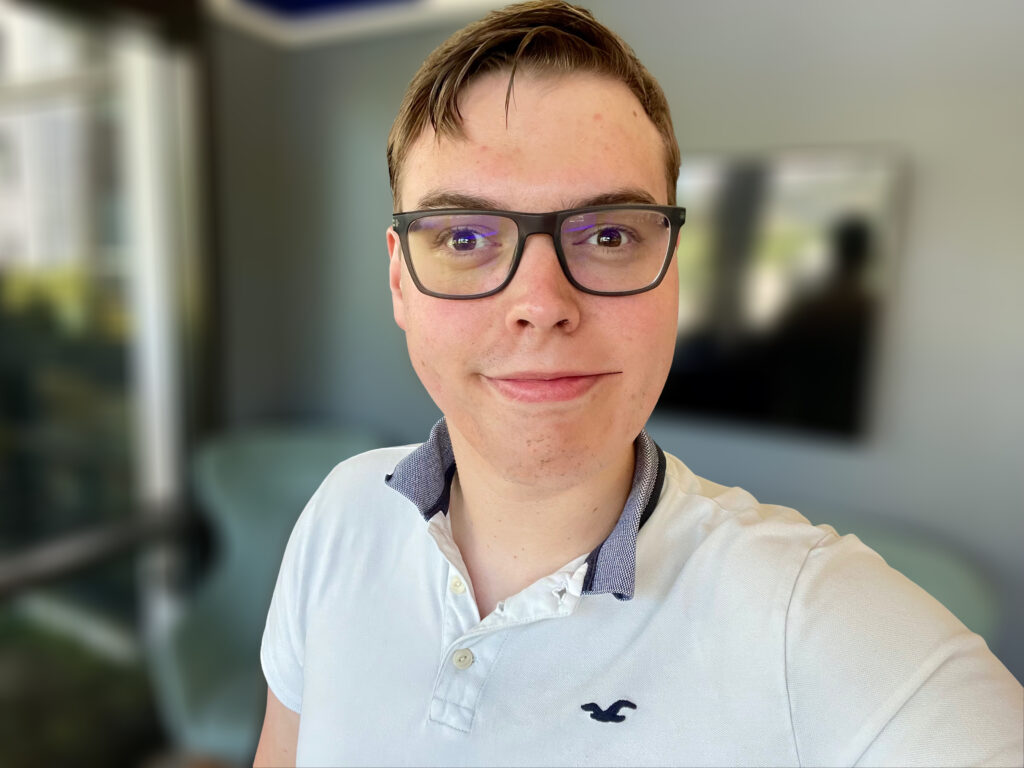
At the start of his studies at the University of Central Florida, Metz earned the U.S. National Science Foundation’s (NSF) Scholarship for Service Award, which supports up to three years of stipends, tuition, and allowances for students in the general area of cybersecurity. This is how he first learned about Trusted CI, the NSF Cybersecurity Center of Excellence, and its Scholars program, a partnership with Sustainable Horizons Institute (SHI).
Through the Scholars program, Metz has presented a poster at the NSF Cybersecurity Summit twice. In his first year, he attended the Summit to share his research interests and introduce himself to the community. Last year, he presented his work on dark patterns in UI and UX, and on how people with vision impairments are negatively disenfranchised.
“I realized that this was something I could really contribute to; that’s why I chose to do my thesis on this topic,” says Metz. “I also found that when I presented at the Summit, accessibility was something a lot of experts hadn’t considered. The larger players are compliant [with the Americans with Disabilities Act or ADA], give or take, but are they really building something user-friendly, accessible, and secure?”
As he prepares to graduate, Metz continues to work with his mentors from Trusted CI, Jim Basney, Principal Research Scientist for Cybersecurity and the National Center for Supercomputing Applications at the University of Illinois at Urbana-Champaign, and Nik Sultana, Assistant Professor of Computer Science at the Illinois Institute of Technology, as well as the larger Trusted CI community. His ongoing research examines how dark patterns in user interfaces impact secure decision-making and usability, especially for individuals with vision impairments.
“Getting introduced to Trusted CI principles, like ‘Secure by Design,’ to the workshops, and to people who do not shy away from difficult things have been a huge propeller of my academic achievement,” says Metz.
He hopes to graduate this year and pursue a Ph.D. or D.Sc. in cybersecurity, with a focus on infrastructure protection, inclusive system design, and public-sector strategy.
“Trusted CI is so much about community,” says Metz. “And in that community, everyone has something to learn, and everybody can learn from anyone. The building of such connections has been incredibly invaluable.”