Sustainable Horizons Institute’s Building Engagement program redefined Wiktoria Zielinska’s STEM Journey
The convention center hall buzzed with the collective energy of the SIAM Conference on Mathematics of Data Science (MDS24), a gathering defined by an absolute dedication to societal advancement through continuous research. For a student stepping into this environment through the Sustainable Horizons Institute (SHI) Building Engagement (BE) program, the atmosphere was both formidable and deeply inspiring. Surrounded by established scholars and researchers, Wiktoria realized that this community represented exactly what she wanted for her own future: a career dedicated to academic rigor and solving complex, real-world problems.
Wiktoria’s trajectory in computer science had evolved rapidly over the preceding years. In August 2023, she took a decisive step by attending the Intro to High-Performance Computing (HPC) Bootcamp at Berkeley National Lab, organized by the Sustainable Horizons Institute (SHI). There, she initially met her future mentor, Dr. Suzanne Parete-Koon, and conducted research on a project fully titled “Energy Cost for Disadvantaged Populations and Methods of Energy Efficiency and Energy Optimization in Computing Systems.” The experience was transformative, solidifying her decision to pursue a master’s degree in computer science.
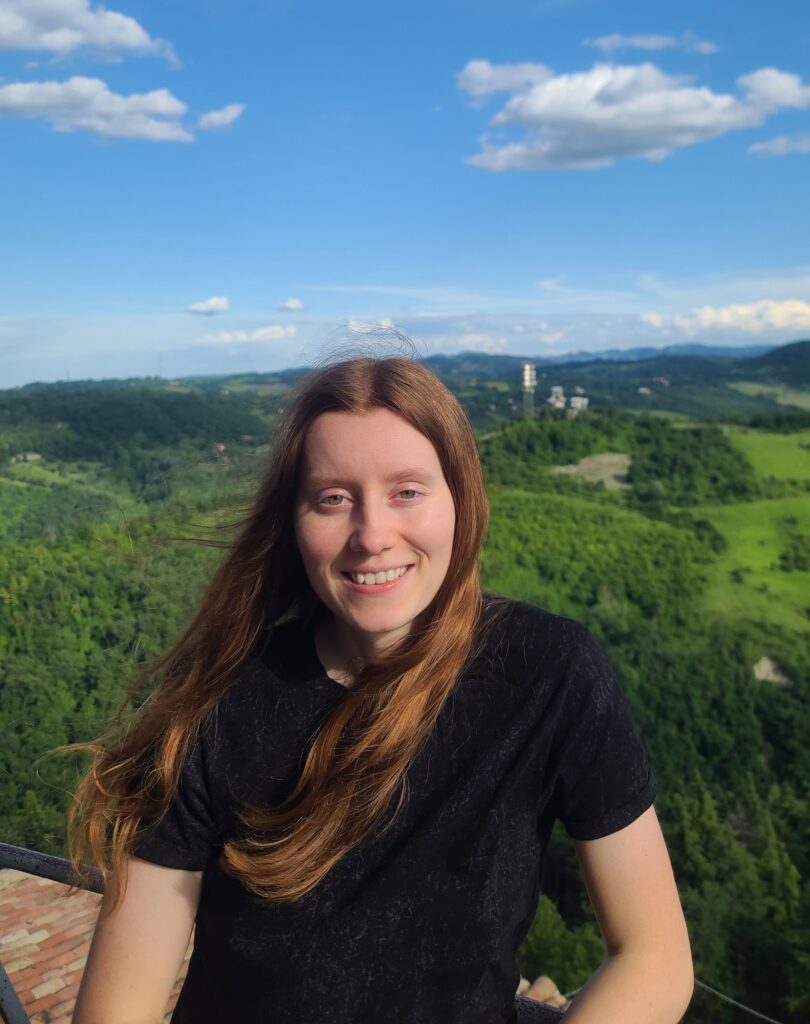
Through SHI’s Sustainable Research Pathways (SRP) program, Wiktoria was later formally matched with Suzanne. One of the main reasons they matched was Wiktoria’s profound enthusiasm to learn and help others, which was exactly what Suzanne was looking for in a mentee. This mentorship led to a summer internship at a leading national laboratory, where Wiktoria worked directly with Frontier, the world’s fastest supercomputer. Her primary project was designing an introductory HPC tutorial and visualizing astrophysics data to make complex computational workflows accessible to beginners. Because they connected so deeply, they decided to extend her internship through the fall semester as well. After successfully completing an Oak Ridge National Laboratory (ORNL) HPC Crash Course certificate, she arrived at MDS24 through the Sustainable Horizons Institute (SHI) Building Engagement (BE) program uniquely equipped to contribute.
The defining moment of the conference occurred during the Hands-on HPC for MDS24 Alternative Session, an event organized by her mentor. Because Wiktoria had already mastered the material, she transitioned from a student to an instructional assistant. Her technical contributions spanned the entire workflow of the workshop, beginning with critical system access support. Wiktoria assisted participants with the multi-step login protocol for the Frontier supercomputer architecture, ensuring everyone was securely authenticated. From there, she provided structured workflow guidance, walking users sequentially through the execution of introductory compilation and optimization commands. Finally, she took charge of technical support by diagnosing terminal connection timeouts, syntax anomalies, and script errors in real time.
As she actively troubleshooted a participant’s connection error, rewriting a faulty command flag to successfully clear the terminal line, Wiktoria experienced a profound shift in professional confidence. She was no longer just absorbing technical knowledge; she was effectively teaching it. Guiding a variety of groups, each bringing unique cultural backgrounds, distinct academic degrees, and varied career stages, instilled a lasting sense of belonging in the STEM field. This experience solidified her core competencies while clarifying her professional strengths. Through real-time interactions, she discovered a genuine passion for technical instruction and academic mentorship. She also verified her strong aptitude for real-time systems debugging under pressure, while simultaneously mastering the ability to establish new professional connections and maintain existing institutional relationships.
The collaboration with her mentor extended well beyond that single event. Both Wiktoria and Suzanne attended the SIAM Conference on Computational Science and Engineering (CSE25). Though they had not initially planned on attending together, they just so happened to go through SHI, where they met up and repeated their success by running the HPC Crash Course together. While they now work in separate directorates at the lab, that does not stop them from finding new ways to collaborate.
Since attending these conferences, Wiktoria’s journey has taken her further than she initially imagined. When she first began exploring opportunities in computer science, she was not even aware of the national laboratory system or the career paths available within it. That changed through her involvement with SHI, which helped her gain a thorough understanding of national laboratories, including Oak Ridge National Laboratory (ORNL) and the value of maintaining professional connections. When Wiktoria was interviewing for a permanent position at ORNL, Suzanne invited members of her prospective team to attend her final internship project presentation, giving them an opportunity to see her work firsthand. Guided by this support, Wiktoria ultimately secured a full-time position as a Linux Systems Engineer at ORNL.
Having previously experienced ORNL from the research side as an intern, Wiktoria now works directly with researchers to understand their needs and develop solutions that support their scientific work. Her role spans a wide range of responsibilities, including managing research computing infrastructure, improving cybersecurity, developing automation and monitoring solutions, supporting HPC environments, and contributing to larger infrastructure modernization efforts. Beyond her technical responsibilities, she collaborates across teams, helps improve internal processes, and takes on initiatives that benefit the broader research computing community. No two days are quite the same, and she enjoys the constant opportunities to learn, solve new problems, and make a meaningful impact.
Wiktoria’s evolution from a baseline participant into a leadership figure within the HPC community highlights a remarkable trajectory. While SHI was not part of the other Intro to HPC bootcamps in 2025 and 2026, Wiktoria was personally invited back to participate in them. In 2025, she returned to the bootcamp as a peer mentor, and by 2026, she rose to the level of a project lead.
Moving forward, Wiktoria remains highly focused on her future academic and professional milestones. She still hopes to finish her introductory tutorial so it can be integrated into the official ORNL HPC Crash Course. Looking to 2027 and beyond, she is actively working to bring this HPC bootcamp model (or a technical bootcamp with a similar structure) to her current workplace at Oak Ridge National Laboratory, transitioning from a participant to a peer mentor, a project lead, and now hopefully an institutional organizer.
Looking further ahead, Wiktoria aims to maximize her academic foundations by pursuing a Ph.D. in computer science or a related field while continuing to expand her technical expertise and leadership experience. She also remains deeply committed to SHI and other organizations that support students and early-career professionals. Her ultimate goal is to build a sustainable, ORNL-focused technical bootcamp program that introduces others to HPC and research computing, inspiring and creating opportunities for future generations just as her own bootcamp experience helped her discover a career path she had never imagined.
Reflecting on her journey, Wiktoria’s advice to prospective BE participants remains clear:
“Programs like these are designed to be catalysts for professional growth. Taking that initial leap of faith opens doors to an expansive, enduring community, ensuring that your first time navigating the frontier of computational science will certainly not be your last”.