
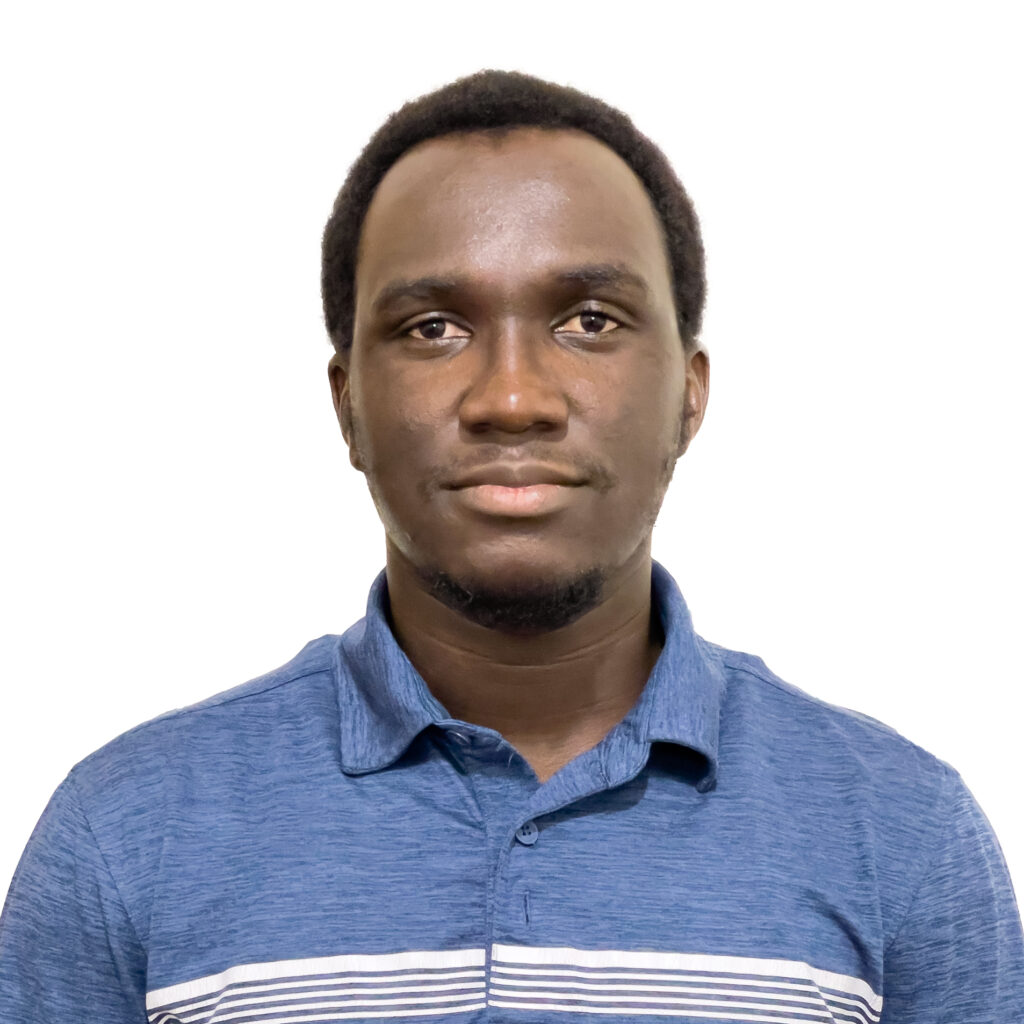
Name: Isaac Bannerman
Pronouns: He/him
Institution: Rensselaer Polytechnic Institute
Department: Mechanical, Aeronautical and Nuclear Engineering(MANE)
Biography:
I come from Ghana, a coastal region in West Africa, and I am the youngest of six siblings. I was fortunate to be the first in my family to attend college and even high school. My undergraduate degree was in Aerospace Engineering, sparking my interest in aerodynamics and fluid mechanics. Teaching has always been a passion of mine, and during my undergraduate years, I spent my summer breaks teaching physics and mathematics at the high school level. This passion motivated me to accept a teaching assistantship position in Ghana for a year after completing my undergraduate education. Looking ahead, I aspire to become a computational scientist after earning my PhD. My focus will be on using numerical methods and programming skills to advance the fields of fluid and solid mechanics. A key source of motivation for me is my nephews, nieces, and children from minority groups. I want to show them that they can achieve their academic potential, no matter where they come from.
Academic Status: PhD Student
Year in program: 3rd
Research Area/Department: Applied Mathematics; Machine Learning/AI; Physics
Other, specify:
Major/Specialty: PhD in Aeronautical Engineering/Machine learning for fluid structure interaction simulations.
Degrees Earned or in Progress: Doctor of Philosophy/ Aeronautical Engineering /2025 [In progress] Bachelor of Science/ Aerospace Engineering / 2019
What courses or academic preparation have you completed to prepare for a summer internship experience?
Fluid mechanics. Fundamentals of finite element. Numerical Computing. Numerical Design Optimization. Machine learning Engineering.
Have you published any research or worked on research/technical projects? No
Where has your research been published or where have you conducted research/technical projects?
Please describe your research/academic interests:
I am interested in the development and implementation of efficient physics inspired algorithms for multiphysics simulations especially fluid structure interactions. I am also interested in the coupling of machine learning and traditional numerical solvers to accelerate fluid structure interactions simulations thus reducing computational cost.
Computational and Data Science Areas:
Applied Mathematics; Computational Science Applications, i.e., Bioscience, Cosmology, Chemistry, Environmental Science, Nanotechnology, Climate, etc.; High-Performance Computing; Machine Learning and AI
Research Synergy:
I am deeply enthusiastic about computational, AI/machine learning, and data sciences research for several compelling reasons, all of which align seamlessly with the work conducted at the DOE labs. First and foremost, these research areas provide a dynamic platform for me to leverage my programming skills in the pursuit of advancing scientific knowledge. As an emerging researcher with a strong passion for programming, I see these fields as a fertile ground to apply my coding expertise to propel the boundaries of scientific discovery. Moreover, I am particularly excited about the prospect of collaborating with DOE lab researchers, as it would grant me access to cutting-edge codes like PETSc and NEK5000. These tools represent invaluable resources that can facilitate my research endeavors, enabling me to contribute meaningfully to the ongoing scientific discourse. Lastly, my current academic journey involves crafting a thesis focused on harnessing machine learning techniques to accelerate fluid-structure interaction simulations. Working on one of the numerous scientific machine learning projects at the DOE labs would not only complement my academic pursuits but also afford me the opportunity to translate my research interests into practical, real-world applications. To reiterate, my profound interest in computational, AI/machine learning, and data sciences research stems from the chance to apply my programming skills to the advancement of scientific knowledge, collaborate with leading researchers, and explore the practical implications of my thesis work. This alignment of interests makes me exceptionally eager to contribute my skills and enthusiasm to the DOE lab environment.
Motivation:
I heard of the SRP from a friend who worked at the Lawrence Berkeley National laboratory and was motivated to apply because of the kind of mentorship and exposure he received while working there. As an emerging researcher, I want to build a network of strong mentors that can guide me and expose me to to the ins and out of the state of the art research ideas in my field and I believe the national labs are one of the best places to find such resources. Secondly, I am aware of some of the innovative products of research from the national labs including the NEK5000 fluid dynamics code; as emerging researcher I would like to contribute to the development of such codes.
Lightning Talk Title: Machine Learning (ML) Accelerated Fluid Structure Interaction (FSI) Simulation