
Less than 30 miles north of Los Alamos National Lab and about 100 north of Sandia National Laboratories, Northern New Mexico College offers its students rare opportunities at the U.S. Department of Energy’s National Laboratories.
“Los Alamos is in our backyard, and a lot of our students get jobs there in STEM fields like engineering,” notes Professor David Torres, Associate Professor and Chair of Mathematics and Physical Science at Northern New Mexico College. What most of Torres’ students don’t get is the ability to work at a National Lab before their junior year.
However, last summer Professor Torres and his student Dominick Martinez worked at Berkeley Lab with Dr. Damian Rouson through the Sustainable Research Pathways for High-Performance Computing (SRP-HPC) program, designed to connect U.S. researchers and project leaders with students and faculty from all across the U.S. and its territories to encourage lasting collaborations, jump start careers, and build innovative workplace environments.
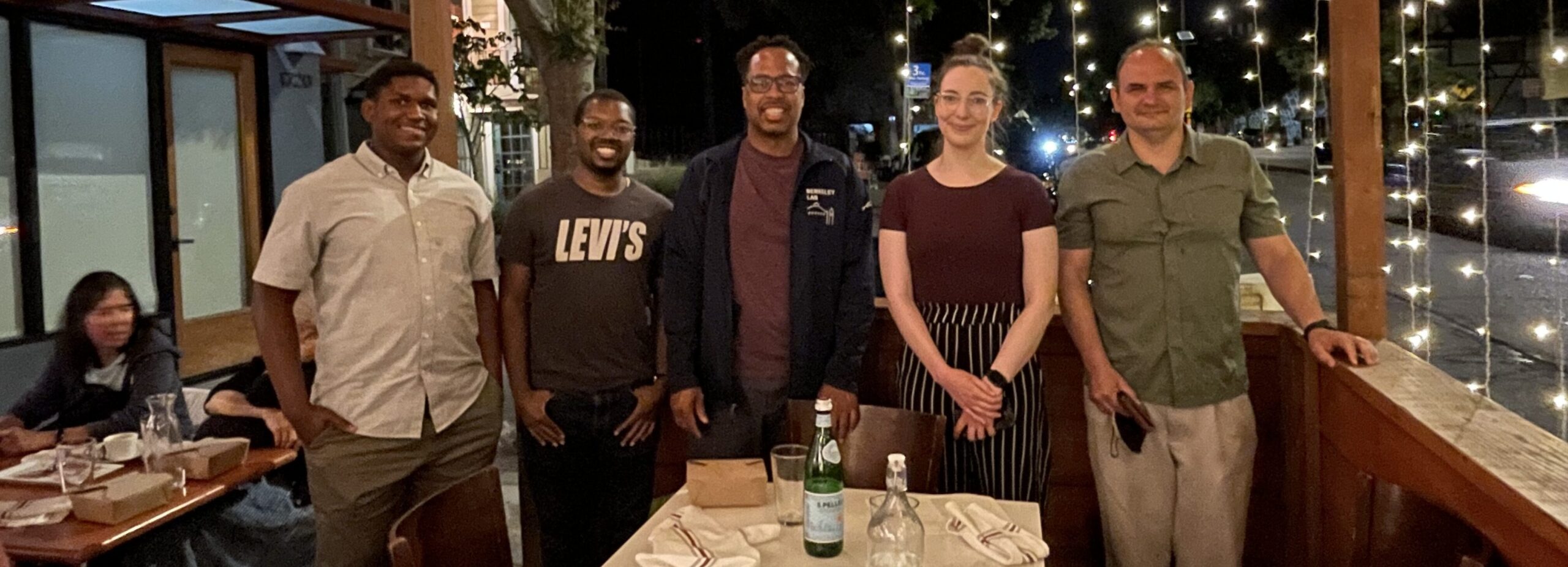
“I always figured I would work at one of the National Laboratories here in New Mexico. That is my goal after I graduate,” says Dominick Martinez. “But I didn’t know very much about high-performance computing. Through this program, I have had opportunities most undergraduates don’t have.”
One of those opportunities was to work in Modern Fortran with one of the leading experts in the field, Dr. Rouson, Group Lead for the Computer Languages and Systems Software (CLaSS) Group at Berkeley Lab. Modern Fortran allows data items to be grouped into objects, which can be instantiated and executed in parallel. Professor Torres’ research revolves around developing a model for T-cell movement to create virtual T cells that move like the experimental biological T cells. “When we first came to Berkeley Lab, we had a serial model, and it wasn’t object-oriented,” notes Professor Torres. “The main objective of the summer was the parallelization and modernization of the code with revision control.”
Professor Torres hopes that such advancements will lead to models that will let scientists observe T cells over much longer periods of time and determine the time required for T cells to search a volume and clear infected cells.
“I am amazed with how much time Dr. Rouson spent with us,” says Professor Torres. “We both learned how to develop code, make revisions, and include documentation so the code can be listed as open source on GitHub.”
As a result of their work last summer, the team has submitted to the Parallel Applications Workshop, Alternatives To MPI+X (PAW-ATM), held in conjunction with SC22, and will continue their research through the academic year. “These collaborations were very fruitful,” says Dr. Rouson. “SRP-HPC has had a powerfully positive impact on my group’s research.”
In addition, Professor Torres and Dominick would like to participate in SRP-HPC again. “I had no idea that Fortran used object-oriented programming and I was not aware of its applications in high-performance computing,” says Dominick. “I am now hoping to learn more Modern Fortran; it is useful in HPC, especially computational physics.”