Name: Nicky Ishaak
Pronouns: he/him/his
Institution: University of Texas, Dallas
Department: Physics
Biography:
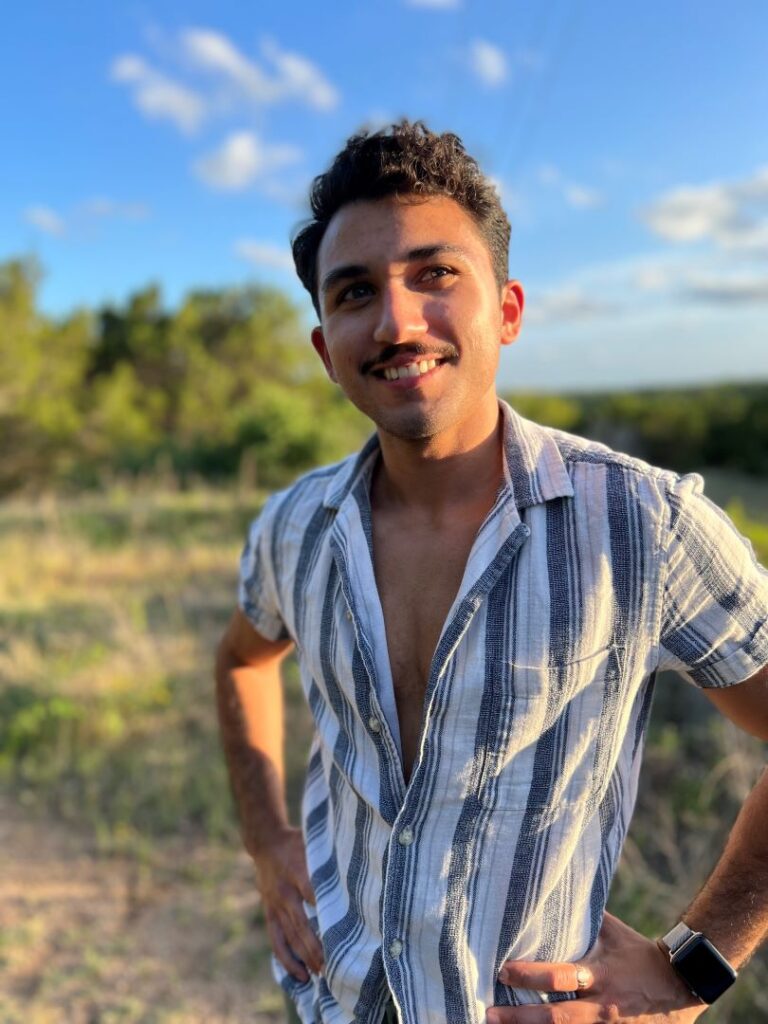
Howdy! My name is Nicky Ishaak and I’m a senior studying physics and mathematics at The University of Texas at Dallas in Richardson, Texas. I work as an online tutor where I tutor high school students in STEM subjects and as a student worker in an on-campus research facility. Outside of academics, and STEM in general, I play guitar, try to read a book a month, love to workout, and have started to fulfill my desire to travel. Also, I’m a Youth Justice Leader for an organization called the National Juvenile Justice Network (NJJN). We work to reimagine youth justice by seeking policy change and practice through an anti-racist lens. All of these aspects of my life are important to me and make me feel purposeful. I love the work I do, academic and otherwise, because I meet incredible people that inspire me to continue my work. Also, I think it’s extremely important to be worldly and not get tunnel vision for one particular area for too long.
Academic Status: Undergraduate Student
Year in program: 3rd
Research Area/Department: Applied Mathematics; Astronomy/Astrophysics; Biology; Chemistry; Computer Science; Data Science; Engineering; Machine Learning/AI; Materials Science; Mathematics; Physics
Other, specify:
Major/Specialty: I’m earning a B.S. in Physics with a minor in mathematics. I’ve maintained a deep interest and curiosity for astrophysics for many years, and that is the general subject matter of the research I do with Dr. Baumann, a professor at St. Edward’s University in Austin, Texas.
Degrees Earned or in Progress: In 2019, I earned my Associate’s of Arts in Government from Austin Community College (ACC) in Austin, Texas. Currently, I’m working towards a Bachelor’s of Science in Physics with a Minor in Mathematics from The University of Texas at Dallas (UTD) in Richardson, Texas. There was a period of two academic years between ACC and UTD that I spent at St. Edward’s University in Austin, Texas. While I was there, I declared a Bachelor’s of Science in Biochemistry with a Minor in Physics because I wanted to take as many STEM courses as I could, but my overwhelming interests lied within physics and St. Edward’s does not have a 4-year physics degree, so that’s why I transferred to UTD.
What courses or academic preparation have you completed to prepare for a summer internship experience?
Currently, I’m a senior and will graduate in May 2024, so I think it would be easiest for me to list the courses I’ve taken over the years that have prepared me for a summer internship. Please see below: 1. Calculus sequence (differential, integral, and multivariable) 2. Linear Algebra 3. Differential Equations (didn’t really touch on PDEs) 4. Contemporary Physics (could be described as “”The Story of Light””; intro to optics) 5. Astronomy 6. Theoretical Physics (essentially a math course that applies a handful of numerical methods used in physics) 7. Classical Mechanics 8. Electronics with lab 9. Thermodynamics and Statistical Mechanics 10. Numerical Methods and Computational Techniques (computationally applying the numerical methods a physics undergrad would learn throughout their academic career; taught in MATLAB) 11. Intro to Python 12. Electricity and Magnetism 13. Quantum Mechanics I 14. Complex Variables 15. Advanced Calculus 16. Theoretical Concepts of Calculus 17. Research in Physics To be taken in Spring 2024: 1. Optics 2. Quantum Mechanics II 3. Numerical Analysis in MATLAB 4. Senior Research Thesis
Have you published any research or worked on research/technical projects? Yes
Where has your research been published or where have you conducted research/technical projects? For the past couple of years, I’ve been working with Dr. Mark Baumann and Dr. Justin Feng on a research project. We use a relativistic N-body solver that we call POMIN. It uses the Post-Minkowski approximation to General Relativity so it is accurate at ultra-relativistic speeds. There are numerous applications for such a solver and our work is focusing on the Breakthrough Starshot project. Proposedly, Breakthrough Starshot is a gram-scale interstellar spacecraft (SpaceChip, if you will) that is attached to a light-sail and is equipped with miniaturized sensors and communicators. Our research looks to answer the question, how do we compute the trajectory of this SpaceChip to send it to the next nearest star system, Alpha Centauri? Calculating this trajectory involves gravitational dynamics between many bodies like the Earth, Sun, Moon, other planets in our solar system, the SpaceChip itself, and the stars and planets in the triple star system. And did I mention that the SpaceChip is moving at 0.2c? Therefore, a Post-Minkowski N-body solver is a great tool for investigating such a calculation. We feel we are at the point where we have conducted a sufficient amount of simulations to be able to publish our findings in a paper. We hope to publish by May 2024.
Please describe your research/academic interests:
Regarding my academic interests, after undergrad, I want to obtain a PhD in physics, astronomy, astrophysics, applied physics, cosmology – not too sure exactly which one yet. That segues into my research interests. Thus far, I’ve been narrow-minded in the sense that I was exposed to astrophysics early on due to my great interest in it, but I don’t feel like I’ve had an opportunity to explore other research areas. I think I would still feel fulfilled if I continued with astrophysics, especially if I hone in on a more particular area of astrophysics such as dark energy, dark matter, gravitational lensing, black holes, etc. However, I’m not opposed to doing research in an area of physics that’s less familiar to me.
Computational and Data Science Areas:
Applied Mathematics; Computational Science Applications, i.e., Bioscience, Cosmology, Chemistry, Environmental Science, Nanotechnology, Climate, etc.; Computer Science; Data Analytics and Visualization; High-Performance Computing; Machine Learning and AI; Quantum Computing and Information Science
Research Synergy:
Well, AI/ML and data science are fascinating areas of research and are developing so quickly that I feel like I don’t know where or how to be introduced to them. AI/ML seems to obscure and niche and data science seems so broad – it’s difficult to navigate those worlds if you aren’t someone who was already involved in them. Of course, there’s coursework offered at my university pertaining to them, but I don’t have the extra time in my degree plan to try them. Also, I would much rather learn something by doing under the guidance and mentorship of someone who can effectively explain concepts that are foreign to me, and then use those skills to conduct research or complete a project. Computational research feels a little more relatable to me. I would describe my own research with Dr. Baumann as such. However, computational research is an umbrella term just as AI/ML and data science are, so I still feel like I have plenty to learn. Based on all of that, I’m interested in working with DOE lab staff and on DOE projects because I believe that education, curiosity and public service are at the forefront of many DOE endeavors. From a research and technical perspective, I believe this approach is the most effective because it allows for meaningful collaboration amongst scientists and the opportunity to continue to learn even though one may hold expertise in another field.
Motivation:
I was fortunate to have the opportunity to participate in the Intro to HPC Bootcamp hosted by Berkeley Lab and facilitated by SHI in August 2023. Prior to the bootcamp, I had a seemingly linear idea of how my academic and career path would evolve. It would go something like complete undergraduate, go to graduate school, maybe work in industry for a few years while applying to professorships and eventually, hopefully, land a tenure-track professorship at a university where I could teach and do my own research. However, post-bootcamp, I had a revelation of sorts. I realized that track was not what I wanted at all. Sure, I still want to get a PhD, but I don’t have an interest in working in industry and I don’t want to teach early on in my career. The bootcamp helped me come to these realizations because I was able to implement skills I’ve learned, collaborate on a research project with a team, and present our research to others – I loved that experience. Also, there were a handful of guest speakers that attested to the ability of working with a team, having the feeling of being in an academic environment, but not the pressure of strict deadlines generally found in industry, and the freedom to express interest in other research group’s work and potentially having the opportunity to work with them. All of this is extremely important to me to have a fulfilling career. Being able to participate in this program feels like the next step in the right direction to be able to accomplish that.
Lightning Talk Title: What I’ve Done, What I’d Like to Try!