
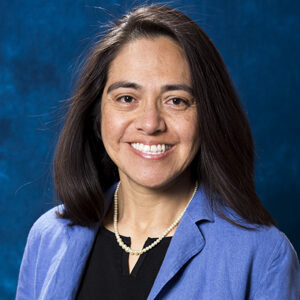
Name: Patricia Soto
Pronouns: she/her/hers
Institution: Creighton University
Department: Physics
Biography:
I am an associate professor of physics at Creighton University, a Jesuit, private, and co-educational university in Omaha, NE. The physics department offers master’s as a terminal degree. Research with undergraduate students is a strength of Creighton, and publishing peer-reviewed articles with undergraduates is an expectation for tenure and promotion. I joined the Department of Physics at Creighton University in August 2007. I came to Creighton after three years at the University of California in Santa Barbara, where I pursued postdoctoral training. An international fellowship from the American Association of University Women partially funded my postdoctoral training. Before coming to the U.S., I attended the University of Groningen, Groningen, The Netherlands, where I earned my Doctorate in Mathematics and Natural Sciences. I grew up in Bogota, Colombia where I received my B.S. (full ride scholarship due to entrance score and high GPA) and M.S. in Physics from Los Andes University. My scholarly legacy is to bridge physical and life sciences in an integrated research and educational program with undergraduates. NSF, Nebraska NSF EPSCoR, and Nebraska NIH IDEA-INBRE have funded my scholarship.
Academic Status: Associate Professor
Research Area/Department: other
Other, specify: Molecular biophysics
Degrees Earned: B.S. in physics 1997 M.S. in physics 2000 PhD in natural sciences and mathematics 2004
Please describe your research/academic interests:
The overarching purpose of my research group is to use integrative computational biophysics workflows to investigate protein conformational dynamics and folding to unravel the molecular mechanisms responsible for amyloid-related neurodegenerative diseases. Currently, we focus on examining the role of protein-lipid interactions in cell membrane remodeling driven by attached peripheral membrane proteins and aggregates. As a result of the SRP program, I am open to discovering new science questions under the umbrella of protein-lipid directions in health and disease. Ultimately, my academic mission is to foster inclusive communities of undergraduates engaged in authentic research experiences.
Computational and Data Science Areas:
Computational Science Applications, i.e., Bioscience, Cosmology, Chemistry, Environmental Science, Nanotechnology, Climate, etc.; Data Analytics and Visualization; High-Performance Computing; Machine Learning and AI
Keywords:
Templated protein misfolding Protein-lipid interactions Cell membrane remodeling Protein fibril Molecular dynamics simulations Prion protein
Research Synergy:
The research in computational biophysics at the DOE National Labs sets the standards in my disciplinary community. Through the years, I have followed the work of leaders primarily from Livermore (cell membrane and membrane protein simulations), Los Alamos (simulations of the full spectrum of biomolecules, from small peptides to the large ribosome), and Oak Ridge National Lab (protein and membrane simulations). In this context, I foresee research synergy as follows: 1. My current theme of protein-lipid interactions will benefit from accessing cutting-edge computational resources and algorithms. In turn, we bring in critical questions to decipher the molecular mechanism of neurotoxicity induced by the three-way interactions between proteins, aggregates, and lipids. As a result of collaborations through the SRP program, we expect to deploy innovative workflows of computational sampling methods and data analysis (including machine-learning based techniques). 2. My research group and I are open to exploring new systems by leveraging our accumulated expertise. We are interested in investigating how nucleic acids and carbohydrates influence protein-lipid interactions in the context of health and disease. I look forward to a scientific exchange that moves forward our science and demonstrates the real possibilities of collaboration between national labs and a primarily undergraduate institution that focuses on educating students in the pre-health track.
Motivation:
The Sustainable Research Pathways program holds immense potential for enhancing my research portfolio. It promises to bolster my leadership in undergraduate research at my institution and in the biophysical society community, lay a strong foundation for a federal grant submission in Fall of 2024, and strengthen my candidacy for full professorship. Envisioning my participation in this program, I anticipate the excitement of a dynamic research-intensive environment. Engaging in stimulating conversations, accessing cutting-edge computational resources, and staying abreast of best practices and trends in my field, including the appropriate use of machine learning algorithms, are just a few of the benefits I eagerly anticipate. This exposure to innovative trends will invigorate my research group upon my return to Creighton. Furthermore, I am committed to translating the knowledge and insights gained during the SRP into enriched classroom materials, ensuring my teaching content aligns with the latest developments in my discipline. In this way, my SRP experience will re-energize my research group and enhance the educational experience I bring to the classroom.
Plan for working with your student team:
Based on my 15 years of experience mentoring undergraduate researchers, my summer research leadership approach is as follows: 1. Orientation: At the start of summer, I introduce students to the values and expectations of our research group, the timeline of each project, and the expected deliverables. 2. Modular Projects: Each student receives a modular project that integrates with others, fostering teamwork while maintaining individual responsibilities. I actively assist in code development (Jupyter notebooks and Google colabs), data analysis, visualization, and interpretation. I engage with students in rigorous observation and analysis as often as needed (a few times per day at the beginning of summer). 3. Daily Group Meetings: To emulate disciplinary best practices, we meet as a whole group every day to a. Share task updates from the previous day. b. Plan daily tasks c. Reflect on and align daily work with the project timeline. d. Cultivate troubleshooting skills as key in computational work 4. Literature Review: To help undergraduates develop expertise and integration of knowledge (key feature due to the interdisciplinary nature of our research), we read: a. review articles that frame the overarching science question we aim to answer b. primary literature that illustrates the implementation of computational techniques in molecular sciences. In the summer months, we meet daily for 30 minutes to annotate and discuss an assigned short section of the article. Although analyzing one article may take few weeks, the approach trains undergraduates to develop scientific reading skills. 5. Skill Assessment: I use a research-based “”research skills growth chart”” to assess student development of research skills. I discuss individually with each student their progress and the support they need to further their skills. My approach prioritizes constant communication, troubleshooting support, and scaffolded skill development. My strategy empowers students to take ownership of their research, fostering accomplishment and a sense of belonging.
Past experience you have working with the students, and any other factors in your decision to include these students on your team:
Sofia Acosta: Sofia was chosen for the Haddix STEM Corridor Summer Research Program at Creighton University through a competitive pre-selection process conducted by faculty. In the final selection round, I accepted her into my group based on her strong academic background in computer science (A.P. Computer Science Principles exam score: 4, top 35% nationally) and basic sciences. During the 2-month Summer 2023 program, Sofia excelled as a confident and capable research student. She demonstrated a deep understanding of our research question’s conceptual framework, recognized its implications for public health, and grasped the value of computer simulations. I highlight her systematic approach to data analysis and in-depth comprehension of the methodology we employ, easily at the level of senior college students! Noah Greenwood: Noah, a biomedical physics major at Creighton University, caught my attention during his freshman year for his ability to meet rigorous academic standards. He joined my research group by the end of his first semester at Creighton and was assigned to a team led by a senior student working on elucidating the binding modes of a pharmacological chaperone to the prion protein. Noah’s remarkable efficiency in completing weekly tasks and critically assessing our workflow and data earned him co-authorship in the article P Soto et al. Prion. 2023 Dec;17(1):55-66. doi: 10.1080/19336896.2023.2186674. In his sophomore year, Noah received the prestigious NIH Nebraska INBRE scholar award at Creighton University. As part of the program, Noah dedicates 10 hours per week to our research group and will work full time under my guidance in Summer 2024. Noah consistently engages in thoughtful discussions, questions every aspect of our methodology, rapidly acquires new skills, and consistently delivers results ahead of schedule. Noah exemplifies academic efficiency while maintaining high-quality standards and a calm and pleasant demeanor. I foresee Noah being the student leader in my research group during his senior year (Fall 2024 – Spring 2025).
Lightning Talk Title:
A structural biophysics model of templated protein misfolding and induced cell membrane remodeling underlying neurodegenerative disease toxicity
Student Information: Sofia Acosta
Noah Greenwood