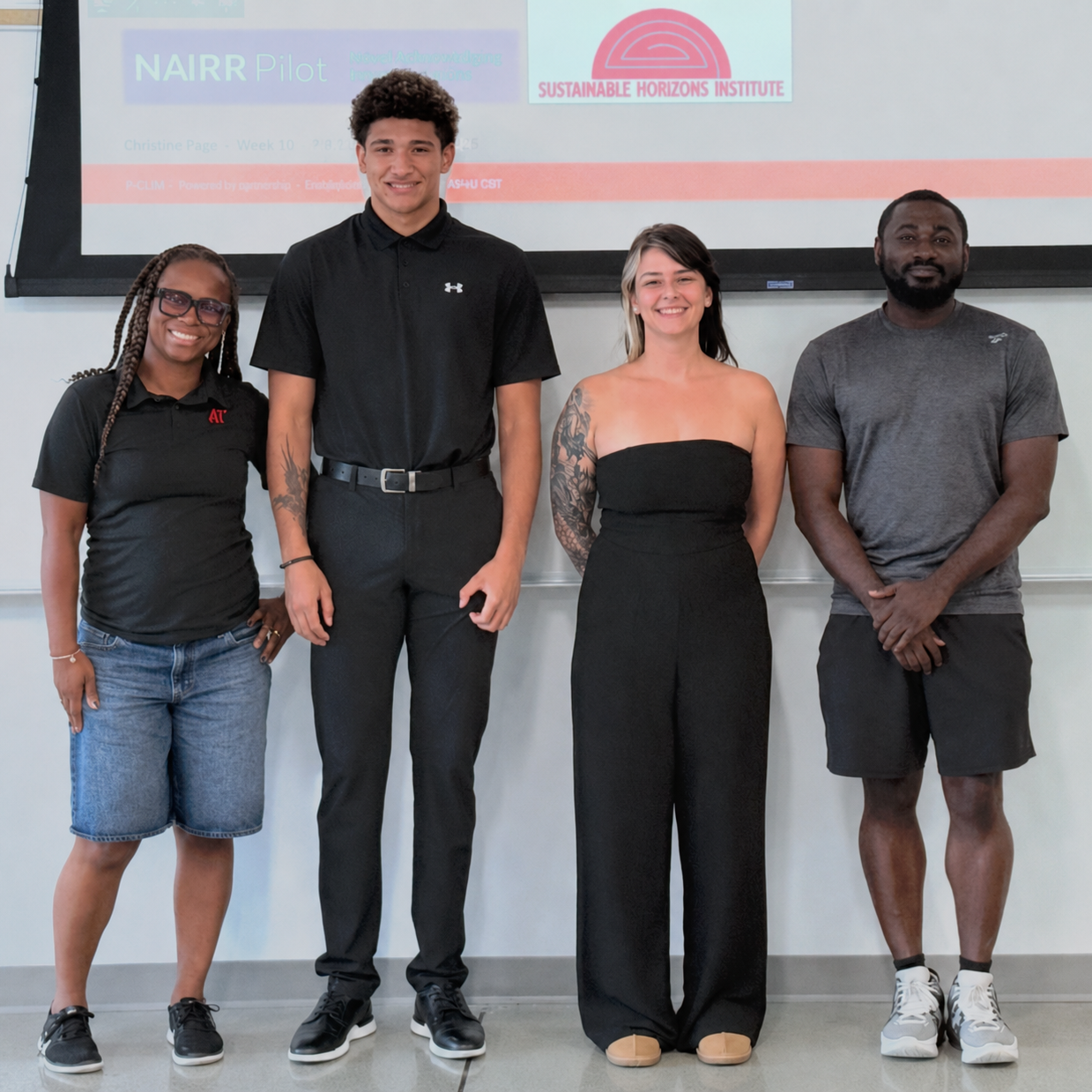
As an early-stage academic who obtained her Ph.D. a year ago, Sabrina Perry, Assistant Professor of Computer Science and IT at Austin Peay State University, was used to working within a curriculum and needing to have answers for either student or advisor questions. So it was liberating to participate in the Sustainable Research Pathways (SRP) workshop as a researcher with a team where answers were not necessarily required. “Now, I can teach students that not everything is perfect. There may be problems or hiccups in our research, so we need to learn how to navigate that,” says Perry. “It was eye-opening.”
Perry and two of her undergraduate students, Floyd Dodwell and Christine Page, were paired with Armstrong Aboah, Assistant Professor of Civil, Construction and Environmental Engineering (CCEE) Department at North Dakota State University. Over the summer, the team worked on a project focused on detecting poisoned cameras in multi-camera object tracking systems such as those used for traffic monitoring, security, autonomous vehicles, etc. Perry underscores the importance of this research, “If an attacker can subtly poison the data coming from one or more of those cameras, it can throw off the system’s understanding of what is actually happening—without making it obvious that something is wrong.”
For 12 years, SRP has designed programs to connect U.S. researchers and project leaders with students and faculty to encourage lasting collaborations, jump start careers, and build innovative workplace environments. Last year, the National Science Foundation (NSF) National AI Research Resource (NAIRR) worked with SRP to pilot an expansion of the program. SRP-NAIRR provides pathways to NAIRR resources by matching NAIRR researchers with a small cohort of faculty and students from a variety of academic institutions to establish research collaborations.
“At our university, we don’t have a lot of the things we need in terms of computing resources, but through the SRP program, we used server/computer allocation of NSF’s ACCESS through NAIRR, which supported the model training and experimentation for the project,” says Perry. “It made our research more seamless and easier than I was accustomed to. The support and collaboration were game changing.”
The experience was transformative for her students as well. “I learned a lot about the utilization of different apps, about workflows, and by being able to see another college campus, I learned how other teams work together,” says Perry’s student Floyd Dodwell. “As a 19 year-old, it was an amazing learning experience for me.”
Perry and her team will be presenting their research at the next Society for Industrial and Applied Mathematics (SIAM) Conference on Computational Science and Engineering (CSE27) with funding from SRP and the NSF NAIRR, Perry will continue tweaking their algorithm to try to achieve better results, and the entire team plan to come back to continue their work with Professor Aboah next summer.
“SRP-NAIRR showed me what kind of work goes into research in a field like cybersecurity. I had the opportunity to connect with a different part of computer science, peers, and faculty that I normally would not have had an opportunity to,” says Perry’s student Christine Page. “I look forward to continuing our research.“