
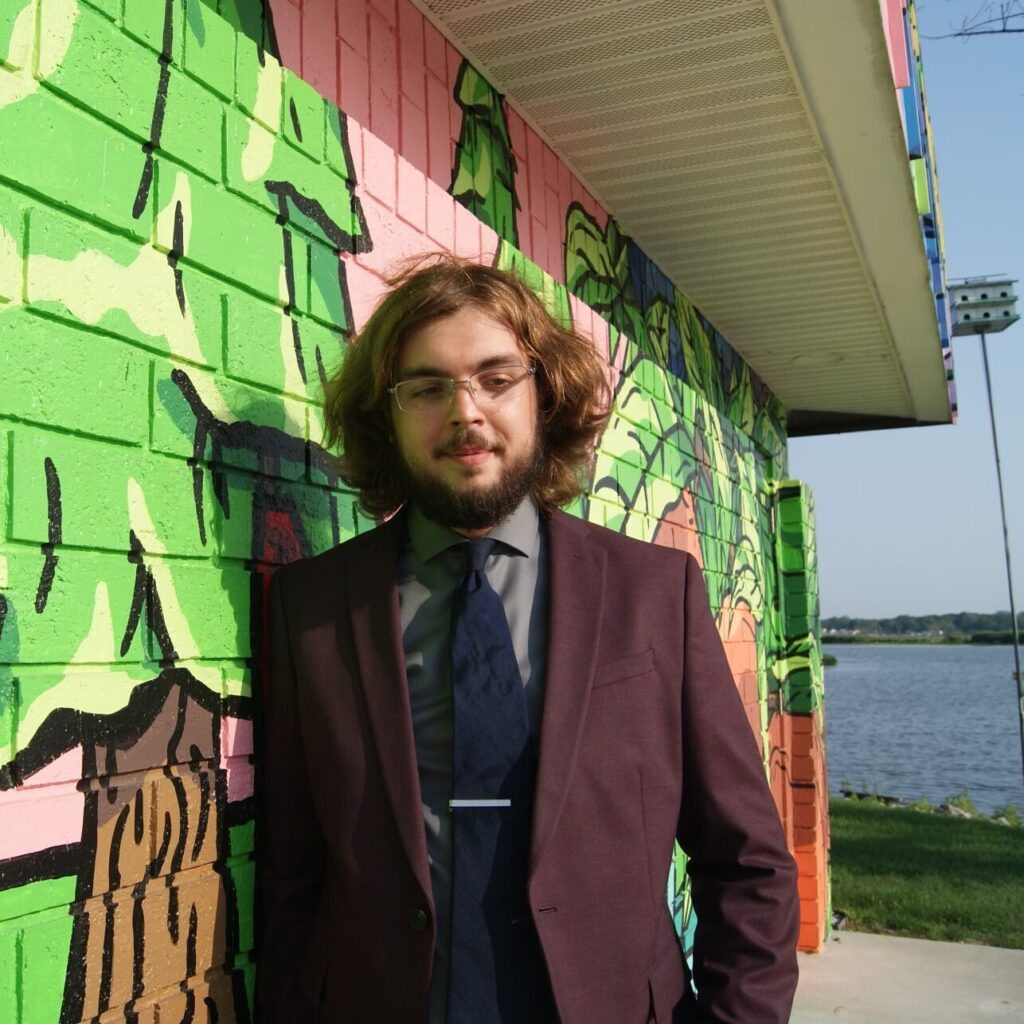
Name: Skyler Ruiter
Pronouns: He/Him
Institution: Grand Valley State University
Department: School of Computing
Biography:
I am a senior at Grand Valley State University studying computer science with a minor in mathematics and employed as an undergraduate researcher for the Applied Computing Institute. Currently, I am researching methods and programs to facilitate biomedical research through data compression and machine learning. I’m also the president of the Computing Club of GVSU, leading dozens of students in gaining technical and interpersonal skills for the world of computing. When I’m not working on research, school, or club, I enjoy spending time with friends and family, playing soccer, reading, and mixing drinks. I had not even considered research as an option going into my junior year of college, but I had received an offer for a research position with a new professor. After working with my mentor for a few months and the opportunity to work with other researchers, I knew that research was the right path for me. Since then, I have been enjoying my time conducting research and have only confirmed my decision to pursue self-improvement through doing the best research possible.
Academic Status: Undergraduate Student
Year in program: 4th
Research Area/Department: Applied Mathematics; Computer Science; Machine Learning/AI
Other, specify:
Major/Specialty: Computer Science/Mathematics
Degrees Earned or in Progress: Bachelors of Science/Computer Science/2024
What courses or academic preparation have you completed to prepare for a summer internship experience?
Computer Science I and II System-Level Programming and Utilities Data Structures and Algorithms Computer Organization and Assembly Language Professional Responsibilities and Practices Introduction to Software Engineering Database Structure of Programming Languages Applied Machine Learning Data Communications Theory of Automata and Computation Operating Systems Concepts Calculus I, II, and III Discrete Structures I and II Linear Algebra I and II Computing and Statistics with R Numerical Analysis Exploring the Earth (Geology) General Biology I
Have you published any research or worked on research/technical projects? Yes
Where has your research been published or where have you conducted research/technical projects? I’ve conducted all of my research at Grand Valley State University (GVSU) with my mentors, Dr. Zachary DeBruine and Dr. Erin Carrier, starting in August 2022. I had initially expressed interest in working with the Applied Computing Institute of GVSU, and Dr. DeBruine took me on quickly as an undergraduate researcher with several other students. Starting research, I worked on a data compression library with my research partner and fellow undergraduate researcher, Seth Wolfgang. The library is called IVSparse and can be found at https://github.com/Seth-Wolfgang/IVSparse. This data compression library was designed with genomic datasets in mind as Dr. DeBruine works with the Van Andel Institute, which conducts a high degree of biomedical research. This project is one that I am continuing to work on as we complete the final stages and has provided me with my very first contribution to the academic community along with two spectacular mentors. During this project, I contributed large portions to the overall codebase, writing the backend and class structure of the library as well as the entire documentation. I also added to the writing of the manuscript, debugging and testing the codebase, dissemination, refactoring the codebase, and library optimization. Recently, I have started working on a new project with the same mentors focused on machine learning, high-performance computing, and applied mathematics. The goal is to train a variational autoencoder to learn genetic information to help predict patient risk from genetic factors. This work is also conducted in collaboration with industry and academic institutions such as the Van Andel Institute and Corewell Health, providing feedback and a potential benefactor for the project. This project being so new makes it too early to discuss contributions, but I wish to expand my research skills in data visualization, academic writing, and benchmarking during this project. At the time of writing this application, the research I contributed to is currently in pre-print status as we wait for the submission for our conference of interest (Data Compression Conference) to open and can be found at https://arxiv.org/abs/2309.04355. Dr. DeBruine: https://www.zachdebruine.com/. Dr. Carrier: https://eecarrier.github.io/.
Please describe your research/academic interests:
My academic and research interests are continually refined as I continue my education, but I am deeply invested in high-performance computing (HPC) and interdisciplinary research involving HPC. The field of HPC has many qualities that I value and find interesting, making it a pillar of my research interests. Firstly, I love to optimize; understanding a codebase or even a single section of code to find ways to optimize the code for specific applications brings me much enjoyment. The ability to leverage tradeoffs in an algorithm or method to glean some way to optimize further is a skill I want to gain a more intuitive understanding of as I grow as a researcher. An example of this is approximate computing, finding where an algorithm can be less precise but improve performance while still being a highly reliable algorithm. This paints a larger picture of my desire to push computing and algorithmic boundaries in the realm of HPC. As previously mentioned, I am also highly interested in interdisciplinary research involving high-performance computing. This is partly due to my deep passion for learning since working with other academic disciplines, such as the biomedical field, gives me a look into their unique characteristics and culture. Working with other disciplines is an opportunity to grow and expand my horizons, as collecting more domain knowledge from varying fields assists in creating new research to push even more boundaries. Scientific computing is a fantastic example of such interdisciplinary research with HPC as it uses the computing power of HPC to solve scientific problems that are often non-computing related. Lastly, I have gained a few interests due to the nature of my research projects, data compression, and machine learning. My primary research project was building a data compression library for redundant sparse data. The ideas of interdisciplinary research and optimization are also significant to the topic of data compression, leading me to them during my project. Machine learning is a newly acquired research interest as I have started working with it for a new project. The incredible power that modern machine learning provides is awe-inspiring, and imagining the coming prospects of the field, especially in conjunction with HPC, thrills me for current and future projects.
Computational and Data Science Areas:
Applied Mathematics; Computational Science Applications, i.e., Bioscience, Cosmology, Chemistry, Environmental Science, Nanotechnology, Climate, etc.; Computer Science; High-Performance Computing; Machine Learning and AI; Quantum Computing and Information Science
Research Synergy:
The massive supercomputers found at the DOE national labs are incredibly impressive and produce immense amounts of data while also being able to process data of similar scale. This access to powerful hardware is one interest I have since solutions to big data is a theme for the research I conduct with my mentors. Pushing the themes of my research to their limits is a goal that greatly intrigues me. At Oak Ridge, researchers developed a supercomputer benchmarking tool that is also open-source, and this work ties into the ideas I previously expressed. Being able to work with massive data, benchmark the most powerful computers, and construct a community around it are all outcomes I resonate with strongly. I feel particularly passionate about the mentioned benchmarking tool for being open-source, as they noted that benchmarking tools are generally a “secret sauce” for supercomputers, making this a powerful tool for helping the community while also being an impressive software tool. When it comes to working with AI at a national lab, I feel strongly that the DOE is one of the best places to work with. The DOE is more concerned with creating robust, safe, and most importantly, moral models. Argonne, Oak Ridge, and other labs all have a strong focus on AI and continue to produce reports and roadmaps for how AI will be or should be used in future projects. An example of this is the “AI for Science, Energy, and Security” report published in collaboration with six national labs. A part of the report that stood out to me was the workforce and ethics section that has as its first grand challenge growing and fostering AI which reflects the demographics of the United States. This shows me that the national labs care about and are conscious of their moral implications for AI software and pulls me to want to work with these types of organizations. The combination of HPC and AI is another significant topic national labs are converging on which interests me. There are many examples, but one very interesting to me was when Oak Ridge researchers developed an AI tool to extract cancer data with record times. This is the type of research I would like to imagine myself conducting in the future as it combines several of the current academic interests I have. This is because this is interdisciplinary research that uses AI and HPC technology to solve real-world medical issues much like I wish my research to accomplish one day.
Motivation:
My primary motivation for wanting to participate in this program is to broaden my research horizons, both from a technical and personal perspective. From a personal perspective, I would love to gain a greater awareness of the world. Little opportunity to travel and a great local college both contributed to rarely leaving my hometown. While West Michigan is quite amazing, there are only so many research opportunities, and only so far to go in HPC research without broadening my scope to more of the world. To take my research possibilities to the next level, I feel that an experience well outside my comfort zone would push me to be a better researcher and a more well-rounded individual. I also wish to meet many more academics in computing. Since I come from a smaller college that does not focus heavily on research and I plan to become a first-generation scholar, my network of academic relationships is currently limited. A summer research opportunity would go a long way in connecting me to the broader research community of HPC, opening many doors as HPC is a very collaborative field that I wish to be a part of. From a technical standpoint, I also am motivated by my desire to grow my hard skills. I am a big believer that one of the best ways to improve your skills is to apply them, and the chance to apply my skills to a national lab would undoubtedly provide me with an enormous opportunity to grow as a developer. I have seen the results of such an experience firsthand through Seth Ockermen’s and Dr. Christian Trefftz’s SRP experiences. The former being my senior and fellow student of Dr. Carrier, and the latter being one of the professors who taught me how to program. I’ve heard details from them about the high caliber of research they conducted and how it made them or their students grow, causing me to be very interested in the program. Overall, I have a strong drive to participate in order to seek personal growth as a researcher, connecting with many different people and building a new community to facilitate this growth while researching a topic that inspires me.
Lightning Talk Title: Ruiter S – Carving Out a Space in HPC