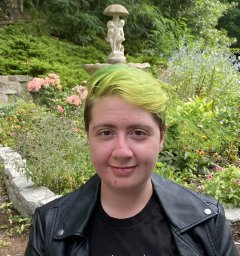
Dr. Polina Shpilker was a Ph.D. student in Computer Science at Tufts University when her advisor invited her to meet Dr. Line Pouchard, who at the time was Senior Researcher at Brookhaven National Laboratory. Dr. Pouchard was at Tufts as part of the Computational Research Leadership Council (CRLC) Seminar Series, a U.S. Department Of Energy (DOE) National Laboratories’ effort to broaden connections with universities and rejuvenate the national labs’ workforce. While Dr. Shpilker could not attend the seminar, her meeting with Dr. Pouchard changed her life.
Both Dr. Shpilker and Dr. Pouchard were interested in metadata. Dr. Pouchard’s seminar examined the methods and benefits of handling provenance of software and data in computer science, in high-performance computing (HPC), and recently in artificial intelligence (AI).
That one meeting led to collaborative research on metadata and HPC. Dr. Pouchard was able to hire and financially support through SHI’s Sustainable Research Pathways program Dr. Shpilker’s last year of Ph.D. studies through one of Dr. Pouchard’s projects.
Dr. Pouchard also joined Dr. Shpilker’s thesis committee as an outside member, and Dr. Shpilker’s project with Dr. Pouchard directly inspired the second half of Dr. Shpilker’s Ph.D. thesis. “My research originally focused entirely on the small-scale things, but working with Line opened my eyes to the larger-scale of HPC. And now rather than having the single-pronged approach to metadata, I am now also looking at both the small-scale and large-scale (HPC) applications of metadata,” says Dr. Shpilker.
Now, she is now a postdoctoral research associate of Workflow and Ecosystem Services at Oak Ridge National Laboratory. “I had no idea that this kind of position, this kind of research field existed or even the concept of working for a government lab and doing this kind of research with metadata. I assumed that to do self-led research, I would have to go into academia. Working with Line helped me see there was another option,” says Dr. Shpilker. “Just having that exposure helped me get an idea of what to expect from academia and industry and how they’re different from each other and from the DOE.”
She is already preparing to pay it forward. As a first generation American, she notes, “I’m still a postdoc and trying to figure out where my research will go from here, but I’m also very interested in talking with students and helping them learn how to do research.” In the meantime, she has already signed up to participate in the seminar series as a speaker that started it all for her—the CRLC Seminars. “Line has retired, so I am going to try to pick up where she left off,” says Dr. Shpilker.