
When Elise Dettling, a senior studying theoretical mathematics at Grand Valley State University in Michigan, applied to the Sustainable Research Pathways for High-Performance Computing (SRP-HPC) program, she thought she was going to a workshop that might be interesting. She didn’t realize it was an internship that would change her life.
Grand Valley State University is primarily a teaching institution; students do not have the research opportunities of many more prominent universities. And while it is known for its business and engineering programs, it is not known for its high-performance computing. “I had never heard of HPC in my life. As a math major you don’t fully get exposed to coding here,” says Elise. “Through this program I learned that HPC is at the intersection of pure mathematics and pure computer science. I love it.”
Sustainable Research Pathways (SRP) is a comprehensive program designed to connect U.S. researchers and project leaders with students and faculty from all across the U.S. and its territories to encourage lasting collaborations, jump start careers, and build innovative workplace environments. Through SRP-HPC, Elise and Professor Christian Trefftz from Grand Valley’s School of Computing were matched with Dr. William Godoy, a Senior Computer Scientist in the Computational Science and Mathematics Division at Oak Ridge National Laboratory (ORNL).
Over the summer, the trio used simple matrix multiplication to compare the speed of high-level productivity models in C, Julia, Python+Numba, Kokkos, and Fortran, with the goal of ultimately comparing portability, productivity, and performance on planned exascale node architectures using CPU and GPUs.
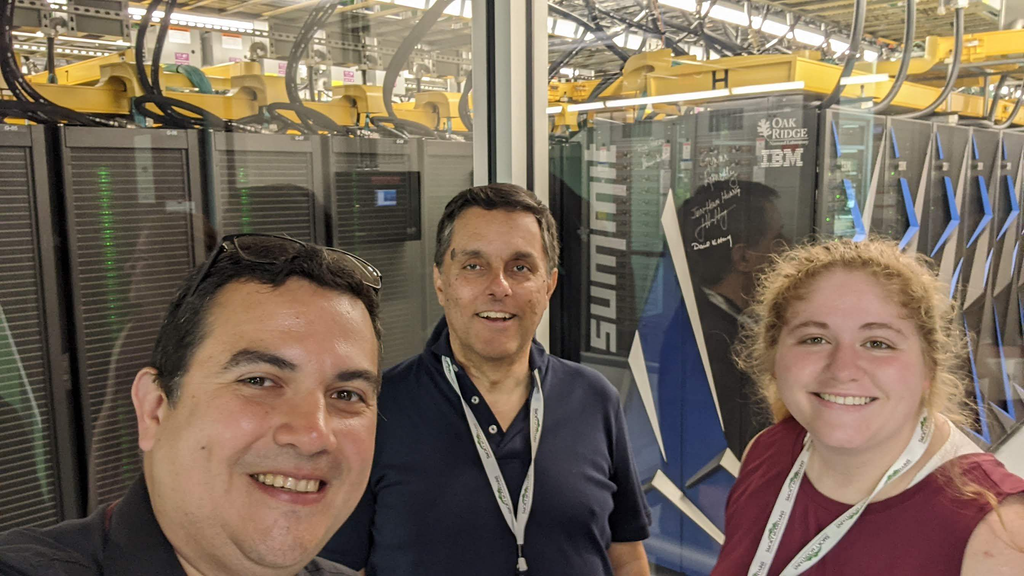
And Elise is not the only one who gained from the SRP-HPC experience. “Going to a place like Oak Ridge National Laboratory was amazing,” says Professor Trefftz. “They are the leading edge for HPC. I have a much better understanding of the size of data being produced and analyzed through the supercomputers at National Labs. It is something we can hardly imagine at an institution like Grand Valley.”
For his part, Dr. Godoy sees programs like this as essential to the progress of HPC overall. “Now we are thinking about redefining fundamental concepts like are we going to build monolithic computers, is cloud computing going to catch up sooner to today’s top supercomputers, and what are the technologies that are going to drive the next 10-20 years in the post-Moore era,” says Dr. Godoy. “If you do something that is widely heterogeneous, you have to bring different perspectives and different ways of tackling this.”
The three have submitted a workshop paper to the International Conference for High Performance Computing, Networking, Storage, and Analysis (SC22) in collaboration with several staff members at ORNL—the first such submission by Elise. She is hoping to go to the conference upon acceptance, present, and network in part to help her applications to graduate school—in Computer Science.
“This gave me fantastic exposure to HPC, and Dr. Godoy’s project was the perfect first introduction to HPC. I couldn’t think of a better project for someone who is just starting out and also for someone at Professor Trefftz’s level, as a senior faculty member,” says Elise. “As a woman from a primarily teaching institution, this has been an incredible opportunity.”