
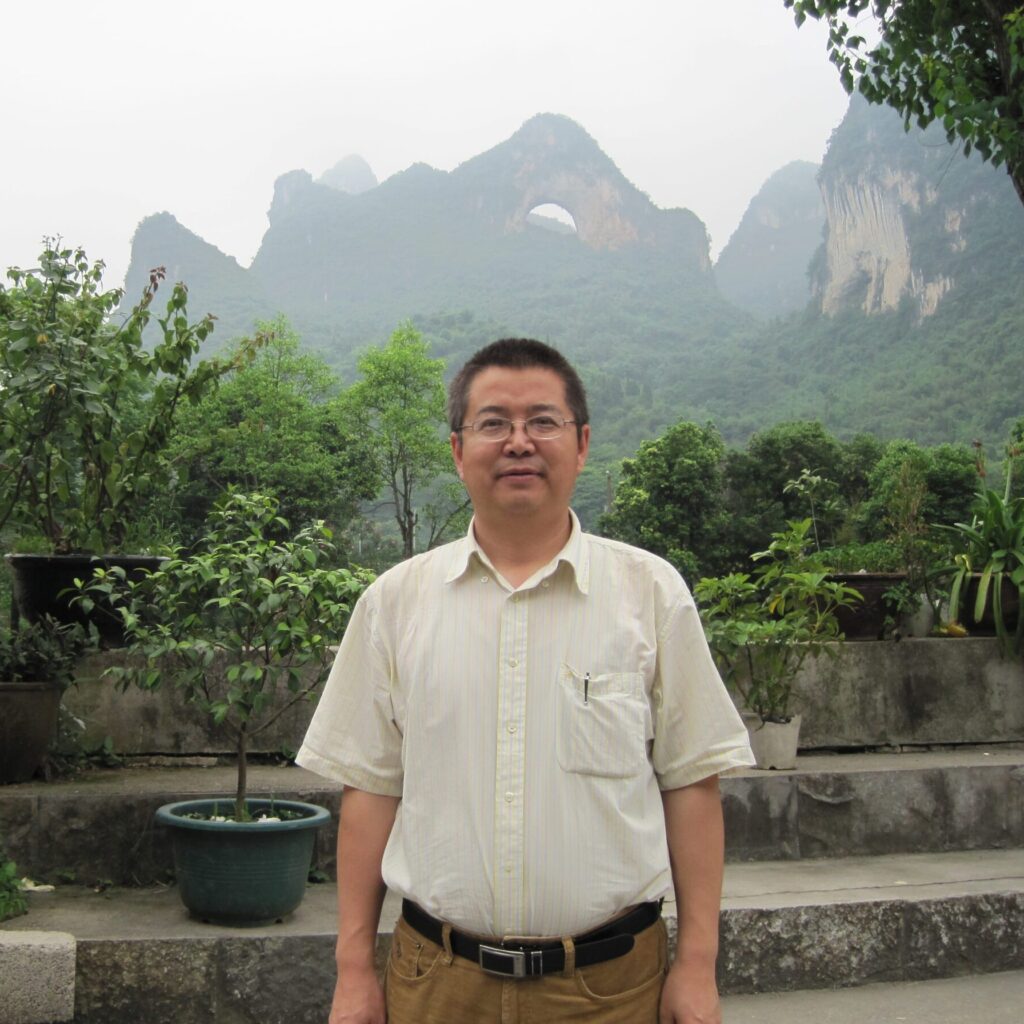
Name: Zhijun (George) Qiao
Pronouns: he/him/his
Institution: University of Texas Rio Grande Valley
Department: School of Mathematical and Statistical Sciecnes
Biography:
Dr. Zhijun Qiao, President’s Endowed Professor, University of Texas Rio Grande Valley. Dr. Qiao received PhD degree of Mathematics 1997 from Fudan University. His research interests include nonlinear partial differential equations, integrable systems and nonlinear cusp solitary waves, KdV equations and soliton theory, integrable symplectic mapping, R-matrix theory, radar image processing and inverse problems in mathematical physics. In 1999, he won one of the hundred best doctoral dissertations in all natural and social sciences in China. From 1999 to 2001, he was Humboldt fellow in Kassel University, Germany. He was awarded the University of Texas Distinguished Research Award in 2013 and the University of Texas President’s Endowed Professor since 2016. Dr. Qiao was the PI of more than 20 national and international research grants. He published more than 150 academic papers and 2 books including top ranking journals Communications in Mathematical Physics, IEEE Transaction on Geoscience and Remote Sensing (TGRS). He is currently serving on the editorial board of Studies in Applied Mathematics and deputy editor-in-chief of Journal of Nonlinear Mathematical Physics.
Academic Status: Full Professor
Research Area/Department: Applied Mathematics; Engineering; Mathematics; Physics
Other, specify:
Degrees Earned: PhD/Applied Mathematics & Mathematical Phyics/1997
Please describe your research/academic interests:
Integrable Systems, Solitons, Inverse Problem of Maxwell Equations, Radar Image and Signal Processing, Neuro Network, Synthetic Aperture Radar (SAR) and Inverse Synthetic Aperture Radar (ISAR) image Reconstructions.
Computational and Data Science Areas:
Applied Mathematics; Data Analytics and Visualization; Machine Learning and AI; Quantum Computing and Information Science
Keywords:
Nonlinear Wave Models, Integrable Systems, Solitons, Inverse Problem of Maxwell Equations, Radar Image and Signal Processing, Synthetic Aperture Radar (SAR) and Inverse Synthetic Aperture Radar (ISAR) image Reconstructions.
Research Synergy:
I worked in the CNLS center at LANL 2001 -2004. Hopefully, I can continue finding some more interests in the areas of applied mathematics and interdisciplinary studies for nonlinear problems.
Motivation:
I want to find some super experts to collaborate with me in solving nonlinear PDEs via ML/DL/AI. In particular, some effective and efficient methods could be used to solve nonlinear differential equations.
Plan for working with your student team:
Currently, one doctoral student (Julio Paez) is working with me in the following interdisciplinary areas: 1) nonlinear wave propagations, 2) analysis of integrability, and 3) multi-solitary wave interactions. For next summer, Julio will be doing more practical application problems in 1) , 2) and 3) after theory is handled.
Past experience you have working with the students, and any other factors in your decision to include these students on your team:
Julio is very active in his designated nonlinear science research. He already had two papers published with me and one paper was submitted to a Q1 journal (the current status is pending). Julio accumulates much research experience and plans to graduate in Fall 2024.
Lightning Talk Title:
Nonlinear wave models
Student Information: Julio Paez